Field Comparison: Journaling a Willow in Spring Versus Autumn
Journal the same willow twice in a year: what to record on spring catkins and leaf burst, what to note in...

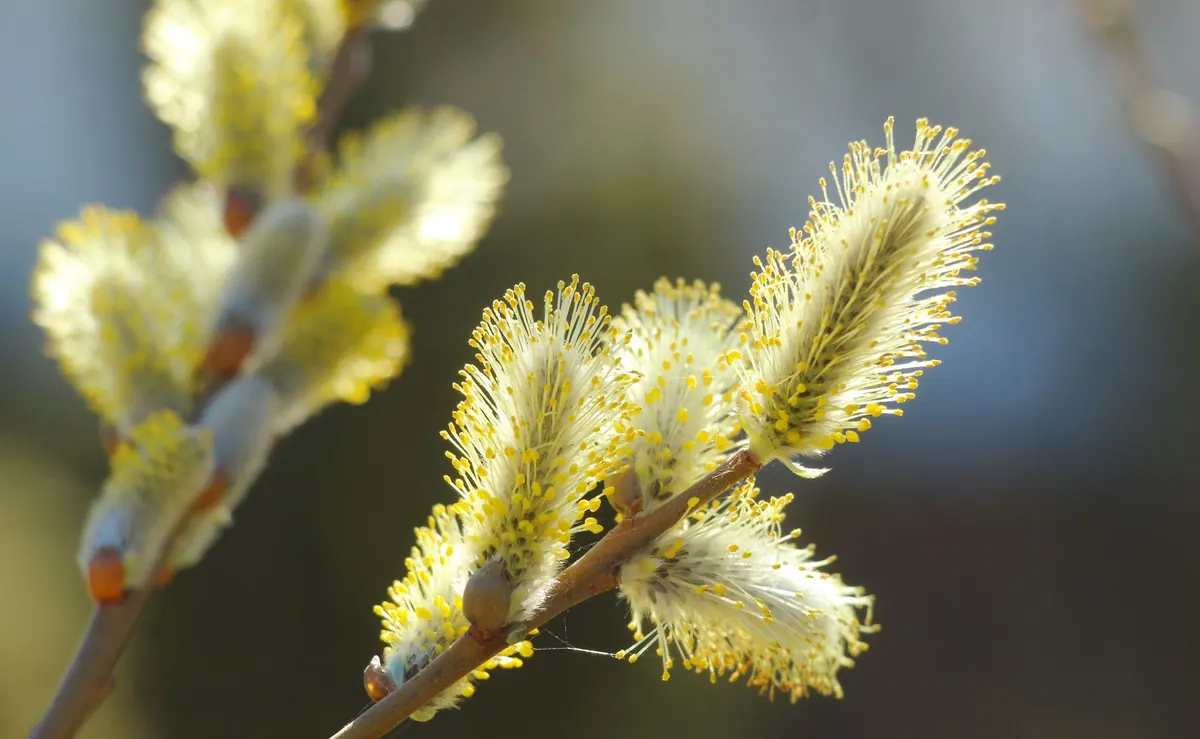
Somewhere along a ditch, a hedge bottom or the muddy edge of a car park, the willows break before almost anything else. You notice the colour first: the twigs shift from dull olive to a warm mustard-yellow, then along the stem small grey ovals appear, tight as pinheads. Within a fortnight they have loosened into the silvery fur you recognise from a florist's bucket. What most people never see is the mechanism underneath, because willows do something unusual. Their winter buds are covered by a single sheath, a cap that slips off whole and drops to the ground. Stand under a goat willow in the first week of March and you will find those caps scattered in the grass like tiny discarded thimbles, each one a dated record of the moment the tree decided spring had begun.
That is the pleasure of journaling willows. The events are small, they are frequent, and they leave evidence. You do not need a wood, a permit or an early start. One tree, visited every three or four days, will give you a richer season than a dozen scattered walks.
Willows are the genus Salix, and they are generous with material. The catkins are "precocious", meaning they open before or alongside the leaves, so the whole drama happens on bare wood where you can actually see it. Male and female flowers sit on separate trees, which gives your notes a puzzle worth solving: once the catkins show, you can sex your tree. And there are dozens of species and hybrids in Britain and Ireland and across Europe, from the huge white willow of wet meadows to the low creeping willows of mountain ground, so a single hedge can hold three plants that will not behave identically.
Willows also root from cuttings with almost embarrassing ease, which is why they line canal banks and flood defences. Keep that in mind as a journal note rather than an invitation: take cuttings only from abundant growth, and only with permission where the land is not public.
Photographs are forgetful; stages are not. Make up a ladder and stick to it all season, so that March's scribbles can be compared with next March's. This one is simple enough to fit in the margin:
Record the date and the stage number at each visit, plus one line about weather since your last call. That weather line explains more of your data than you expect: a cold fortnight will hold stage 3 for ten days, then three warm ones will run you from 4 to 7 in a week.
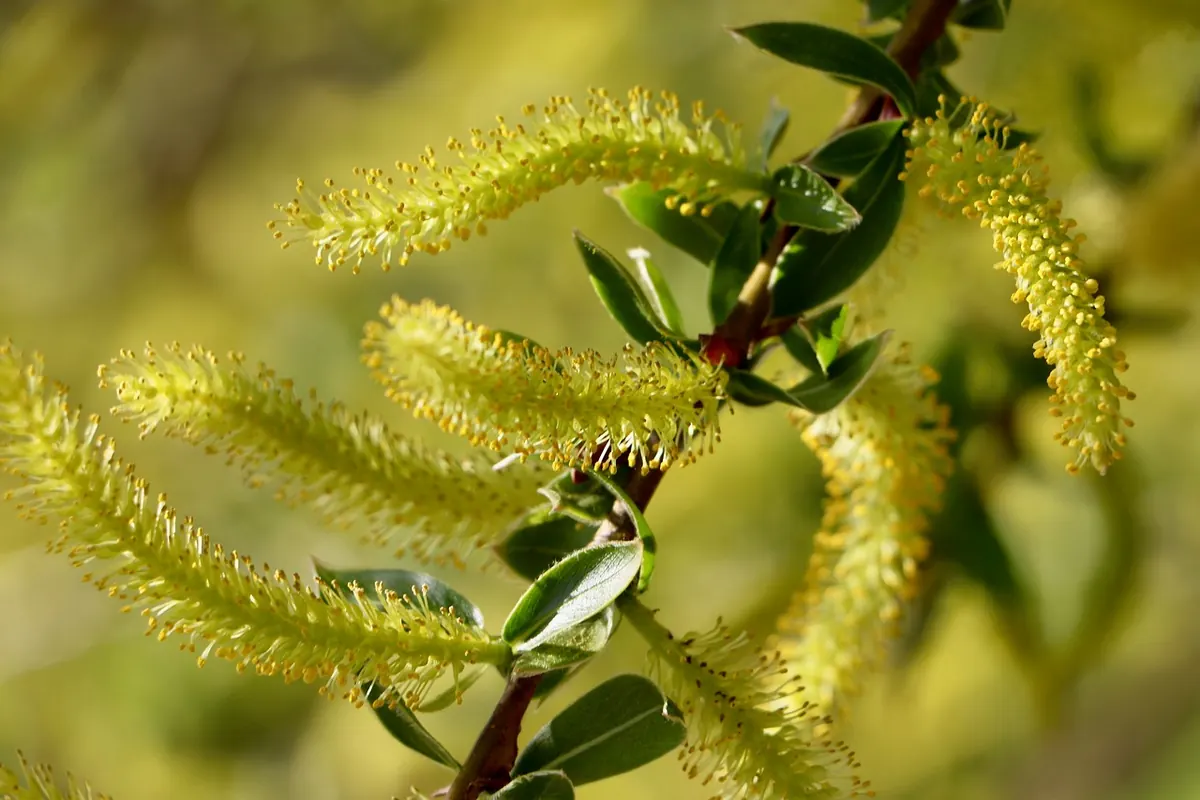
The familiar grey "pussy" stage is not a flower yet, it is a cluster of buds inside the catkin waiting to open. What happens next depends on which tree you are standing under. Male catkins swell and turn gold as the anthers mature, dusting your finger if you tap them; before they open, the anthers can look red or orange on some species. Female catkins stay green and modest, with small forked stigmas that catch pollen brought by early bees and bumblebee queens. After pollination, female catkins lengthen into strings of little green capsules and eventually fluff into white cotton, which is the seed being carried off on the wind in late April or May.
Goat willow and grey willow flower well before their leaves. White willow and crack willow open nearer to leafing. Note which you have; the difference between a bare tree in flower and a green tree in flower is a real field mark, not a small one.
Your own dates will shift with latitude, altitude and species, but an example shows how much detail a short entry can carry.
4 March. Hedge bottom, west side of the lane. Twigs yellow. Buds stage 2–3, caps beginning to lift. Cold wind, no insects.
11 March. Caps everywhere on the grass, dozens. Catkins stage 4, silver, about 15 mm. One bumblebee queen working the sunny side.
18 March. This tree is male. Anthers gold, pollen visible. Catkins to 30 mm. First leaf tips showing at the shoot ends.
27 March. Leaves to 25 mm, silvery underneath. Catkins starting to brown at the tip. Sketch of stipules at the leaf base.
Draw the shed cap from above (a curved shield with a ragged edge) and in profile. Add the scar it leaves on the twig, a pale circular wound. That scar is your proof of which tree you are looking at when the catkins are gone.
Sketch the whole catkin at actual length beside a ruler drawn in the margin, then a single flower at ten times the size from a hand lens. On a male flower, mark the stamens and count them; on a female, draw the flask-shaped ovary and the two stigmas. Colour the anthers with a pencil point rather than describing them as "yellow" — yellow is a dozen colours.
Willow leaves are simple and long, usually with fine teeth along the margin, and many carry two small leafy flaps, the stipules, at the base of the stalk. On vigorous shoots these can be big enough to draw properly. Note whether the underside is hairy or smooth: the white willow is named for it.
You need less than you think: a notebook that takes pencil and watercolour without buckling, a 10x hand lens, a short steel ruler for millimetre measurements, two pencils (HB and a green or yellow one), and a waterproof pen for dates so they survive a damp pocket. Tag one low branch with a paper label and a soft tie, and return to that same branch each visit rather than wandering the crown looking for something interesting.
Then keep a simple rhythm. Visit on days three, seven, ten and fourteen after your first stage-2 bud, and write the same four lines each time: date, stage, measurement, one observation you did not expect. If you can, photograph a single marked catkin against a coin for scale. At the end of the season, your twelve entries will read as a calendar of one tree's spring, and next year's will be a comparison rather than a beginning.
Photo: Gosia K / Pexels
Journal the same willow twice in a year: what to record on spring catkins and leaf burst, what to note in...
A seven-day journaling project that tracks temperature, rain, wind and wildlife on the same route at the...
A twenty-minute garden routine that gets children looking closely: simple prompts, quick drawing tasks,...