How Weather Changes Affect Daily Nature Notes: A One-Week Tracking Project
A seven-day journaling project that tracks temperature, rain, wind and wildlife on the same route at the...

Pick one willow. Not willows in general, not the pond, not the walk that passes them — one tree you can reach in ten minutes and stand beside without feeling conspicuous. Then visit it twice: once when the catkins break, once when the last leaves go. Six months apart, same notebook, same questions. The comparison is where the learning hides.
Spring and autumn ask for different kinds of attention. Spring is an event. Things arrive, and arrive fast, and if you miss a week you miss a stage entirely. Autumn is a subtraction, slower and easier to fool yourself about. A tree that is 40 percent leafed-out on 14 March is unmistakable; a tree that has lost 40 percent of its leaves is something you will describe from memory as "mostly green" when it was, in fact, mostly gold. Writing both down separately, before you compare, is the whole method.
Fix the frame first, or the two entries will not be comparable. Choose a branch you can reach, at chest height, on the side of the tree you approach from. Tie a short length of gardener's twine around its base — something that will survive winter wind and won't cut into the bark. That branch becomes your sample. Everything you measure, count or sketch, you do there.
Keep the page template identical in both seasons: date, time, weather, how the air feels, water level if there is water nearby, one sketch, one measured thing, three words for colour, one sound, one question you cannot answer yet. Twenty minutes is enough. A two-hour sitting produces one page and a lot of standing about.
The willow gives you two or three weeks of high information, and then the tree is simply leafy and much harder to read. Go every eight days if you can. If you can only manage one visit, go when the catkins are half out — that is the moment when the most parts of the tree are visible at the same time.
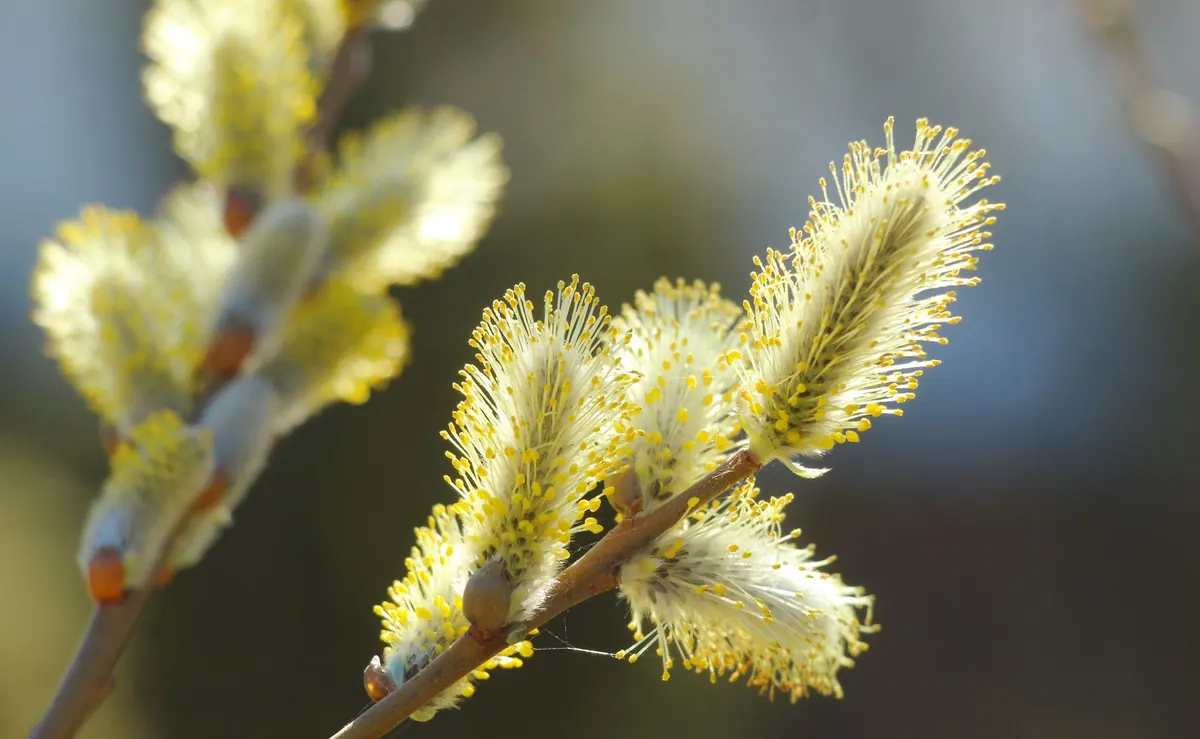
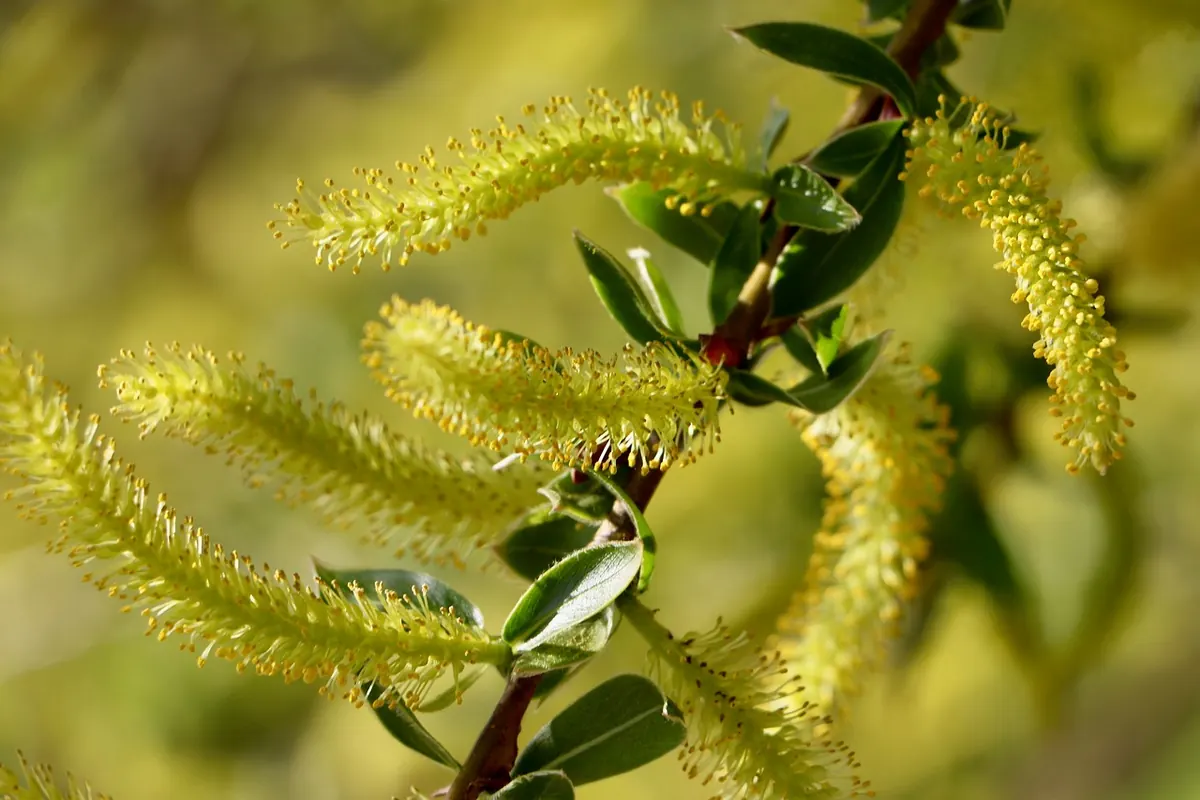
Willows are usually dioecious, which means male and female flowers grow on separate trees. This matters for your notebook. A male catkin in full flower shows yellow anthers, sometimes so thick with pollen it looks dusty; a female catkin is greener, with stigmas that look like tiny threads. If you have been calling your tree "the pussy willow" for years, spring is when you find out what it actually is. Record the date the first catkin opens, its colour before and after, whether it stands upright or hangs, and whether the anthers have opened yet.
Goat willow flowers before the leaves, on bare grey wood; many of the osiers and the white willows flower as the leaves come or after them. That ordering, written down with a date, is worth more than any photograph.
Turn a new leaf over. Willow leaves are pale beneath — the white willows are silkily hairy on the underside, which is why the tree shimmers when the wind turns the leaves. That silvery underside fades as the season goes on. Note how pale it is in the first week of leaf-out; you will want that baseline in autumn.
Willows are among the last trees to let go. Long after the birches are bare, a willow will still be carrying dull green and yellow leaves, and this is exactly why autumn notes need discipline: the tree changes so gradually that each visit feels like no change at all, and then one gale takes the whole month at once.
"Yellow" is not a record. Take three leaves from the tagged branch and name them against something real: lemon, ochre, olive, brass, that particular pale gold of old varnish. Note whether the colour starts at the leaf edge and moves inwards, or the reverse, and whether the first leaves to turn are the ones nearest the tip or nearest the trunk. Press one leaf flat between two pages and write the date beside it — a pressed leaf from October is a better colour reference than any word.
Sit with the branch close to your face. Where each leaf has fallen, a leaf scar remains, usually a narrow crescent with three small dots inside — the bundle traces that once fed the leaf. Sketch one at three times life size and count the dots. Willows form their catkin buds the season before they open, so by late autumn the buds that will flower next March are already visible, firm, and often a different colour from the leaf buds. Measure them. Then, in spring, measure them again.
Do this indoors, in February, with both entries open on the desk. The useful comparisons are rarely the ones you expect. Shoot extension between spring and autumn tells you how much the branch actually grew. Bud width in October compared with bud width in March tells you how much swelling happens before the catkin opens — usually more than you'd guess. And the gap between leaf-out date and leaf-drop date, written as a single number of days, gives you one honest figure for the year.
You will also find the places where you were wrong. Perhaps you noted in March that the catkins were "nearly over" and then found, on the next visit, that they had a fortnight left in them. Perhaps you wrote "green" in October for a branch that had already turned. Those corrections are the most valuable lines on the page, so leave space for them. Go back and add a note in a different ink: "wrong — still flowering on the 2nd."
If you want to try this without committing to a whole season of visits, use three: one in early March or whenever the catkins first show colour, one in late October, and one short return in early December when the branch is bare. The December visit is the one people skip and the one that makes the comparison work, because it lets you see the leaf scars and the next year's buds without foliage in the way.
Take a pencil, a fine-liner, a small ruler, a few sheets of blotting paper for pressed leaves, and the twine. Dress for standing still. Sketch at least once per visit, even badly — drawing forces you to count bud scales and look at the underside of things that a photograph lets you skim past. Write the date and the time at the top of every page before you look at the tree, and write one question at the bottom before you leave. Then put the notebook away until the next visit. The willow will keep its side of the bargain.
Photo: Nennieinszweidrei / Pixabay
A seven-day journaling project that tracks temperature, rain, wind and wildlife on the same route at the...
A twenty-minute garden routine that gets children looking closely: simple prompts, quick drawing tasks,...
A seasonal field guide to willow budburst: reading the single bud scale, telling male from female catkins,...